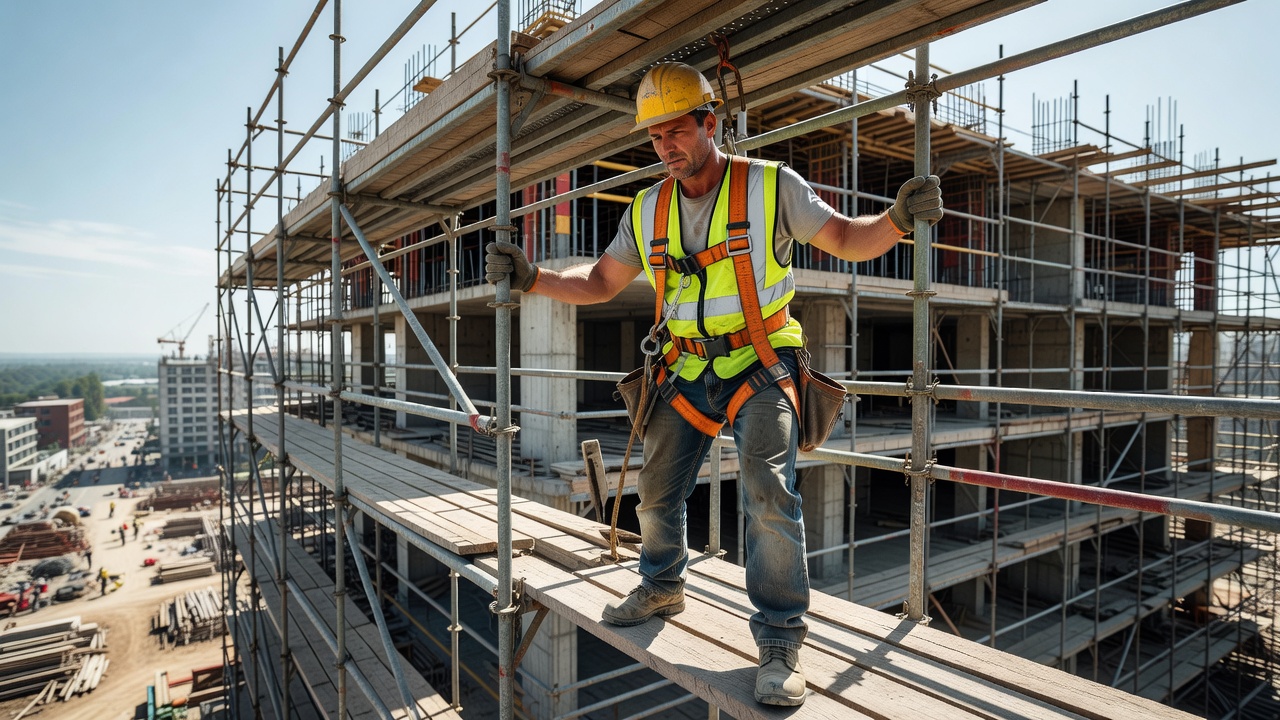
Over the past decade, Malta's skyline has transformed dramatically. With vertical development accelerating in areas like Sliema, St. Julian's, and Mriehel, the construction industry faces new, elevated risks. Falls from height remain the leading cause of fatal accidents in the Maltese construction sector, making stringent fall protection not just a regulatory requirement, but a moral imperative.
The Occupational Health and Safety Authority (OHSA) has recently tightened enforcement on high-altitude work sites, issuing immediate stop-work orders for non-compliance. Here is a definitive guide to the essential fall protection gear required for high-rise builds in Malta.
1. The Full-Body Harness (EN 361)
The standard toolbelt is no longer sufficient. Any worker operating near an unprotected edge must wear a full-body harness compliant with European Standard EN 361. The harness must distribute the force of a fall across the thighs, pelvis, waist, chest, and shoulders.
- Malta Climate Factor: Due to Malta's high summer temperatures and humidity, contractors should invest in harnesses with moisture-wicking padding to prevent heat exhaustion and ensure workers actually wear them correctly.
- Inspection: Harnesses must undergo documented visual inspections before every shift. UV degradation from the strong Mediterranean sun can weaken webbing over time.
"Safety gear is only effective if it is worn correctly. A harness worn loosely over the shoulders provides a false sense of security and can cause fatal internal injuries during a sudden arrest."
2. Lanyards and Shock Absorbers (EN 355)
A harness must be connected to an anchor point using an energy-absorbing lanyard. In the event of a fall, the shock absorber tears open, drastically reducing the impact force on the worker's body to below 6 kilonewtons (kN).
Twin-tail (Y-shaped) lanyards are highly recommended for scaffolding erection and steelworks, allowing workers to maintain 100% tie-off while moving between anchor points.
3. Edge Protection and Scaffolding Parapets
Personal Protective Equipment (PPE) is considered the last line of defense. The primary strategy must be Collective Protection. Under Maltese OHSA guidelines, all open edges, stairwells, and lift shafts must be secured with rigid guardrails comprising a top rail, mid-rail, and toe board.
For high-rise concrete structures, mesh barrier systems are becoming the industry standard, preventing not only personnel falls but also stopping debris and tools from falling onto public streets below.
4. Anchor Points (EN 795)
A fall arrest system is entirely useless without a certified anchor point. Tying off to temporary scaffolding tubes or exposed rebar is strictly prohibited. Anchor points must be engineered and certified to withstand at least 12 kN of dynamic force. On modern Maltese sites, cast-in anchor points are increasingly being integrated directly into the concrete slabs during the pouring phase.
Conclusion
As Malta continues to build upward, the culture of safety must elevate alongside the architecture. Equipping workers with certified, comfortable, and well-maintained fall protection gear is the absolute minimum requirement. Contractors looking to ensure full compliance should consult with certified safety auditing companies to design bespoke fall prevention strategies for their specific sites.